The four ways to buy a website (real 2026 prices)
Every option looks cheap or expensive until you count the whole bill — your hours, the maintenance nobody mentions up front, and the leads a site loses while it sits there looking pretty. Here is the honest comparison:
| Option | Sticker price | The hidden bill | Who it actually fits |
|---|---|---|---|
| DIY builder (Wix, GoDaddy, Squarespace) | $20–$50/mo | 30–60 hours of your evenings — and you become the admin forever | Owners with a slow season and a lot of patience |
| Freelancer | $1,500–$5,000 one-time | Hosting, edits, and fixes billed hourly; the freelancer often disappears within a year | A brochure site you never plan to touch |
| Marketing agency | $1,000–$5,000+/mo | 6–12 week build timelines; an invoice every time you want a phone number changed | Multi-crew companies with ad budgets |
| Done-for-you system (J1 Systems) | $297/mo flat | None — build, hosting, edits, and management included | Owner-operators who want the phone to ring, not homework |
The pattern to notice: the cheap options charge you in time, the expensive ones charge you in retainers, and almost none of them are paid to do the thing you actually want — make the phone ring and catch the call when it does.
What a website costs by trade — and what one missed call costs
The right question isn’t “how much is a website?” It’s “how much is a missed call?” — because that’s the number a working website protects. Whether you run a plumbing company, a barbershop, a landscaping crew, a detailing shop, or a roofing operation, the website price is the same. The missed-call price is not:
| Trade | Typical job ticket | What one missed call costs |
|---|---|---|
| Roofing | $8,000–$20,000 | One missed call can out-cost 5+ years of any option above |
| HVAC | $350–$900 (installs far more) | 1–2 missed calls a month erases the website budget |
| Plumbing | $175–$450 | A few missed emergencies a month is the whole bill |
| Landscaping | $100–$500 (recurring contracts more) | One lost recurring account = thousands per year |
| Barbershop / grooming / detailing / phone repair | $50–$200 | 10–30 calls a day — small tickets, but the misses add up daily |
| Handyman | $150–$600 | Every missed call is a neighbor who found someone else for life |
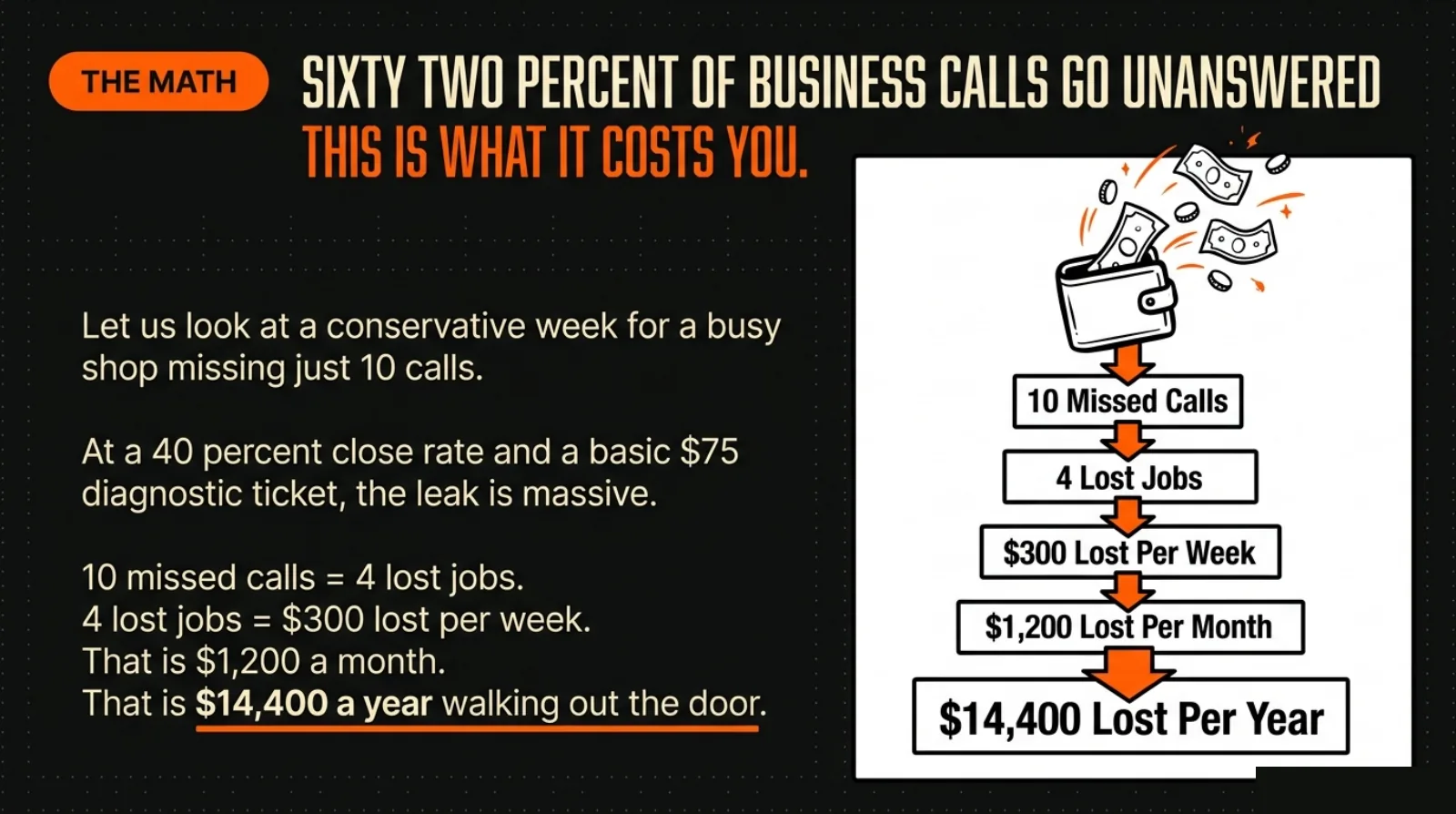
Even at a conservative $75 average ticket, 10 missed calls a week at a 40% close rate leaks about $14,400 a year. Run your own trade’s numbers in the Missed Call Revenue Calculator — it takes about three minutes and uses your tickets, not averages.
What $297 a month actually includes
J1 Systems doesn’t sell “a website.” It sells the system a local service business needs to turn searches into booked jobs — installed, managed, and improved for a flat $297/month:
- A full site built for your trade and service area — the pages that show up when someone in your city searches for what you do, live in days, not agency months.
- Your Google Business Profile wired to it — the map listing and the website working as one, because most local searches never leave the map.
- Missed-call text-back — when you can’t pick up (on a ladder, under a sink, mid-cut), the caller gets a text back in under a minute instead of dialing your competitor.
- A review engine — steady, asked-for reviews that build the social proof buyers check before they call anyone.
- One lead inbox — every call, text, and form in one app, so nothing falls through.
And the guarantee carries the risk, not you: live in 14 days or your month is free, 30 days unconditional, and after that we keep working free until it performs. Compare that to a $3,000 build that ships, invoices, and walks away. Want it priced against your situation? Book a call.
Why the cheapest website is usually the most expensive
A $20/month DIY site that never gets finished, never ranks, and rings to voicemail isn’t saving you money — it’s quietly spending it. The one-time $2,500 freelancer site decays: plugins age, the phone number changes, the “contact us” form breaks in month eight, and nobody notices until a customer mentions it. The $0 option — the Facebook page standing in as a website — loses every buyer who wanted to see your work, your reviews, and your service area before calling.
The honest three-way comparison is in Agency vs DIY vs Done-for-You. The full breakdown of what a site needs to actually book jobs — not just exist — is in our guide: Websites That Book Jobs.
Frequently asked questions
How much should a small business pay for a website?
For a local service business, $200–$400/month for a managed system is the healthy range — enough to include the build, hosting, edits, and lead-capture tools without the $1,000+ agency retainer. Pay less and you’re doing the work yourself; pay more and you’re funding an agency’s account managers.
Is a cheap $500 website worth it?
Only as a placeholder. A $500 build typically ships 3–5 generic pages with no service-area pages, no review engine, and no missed-call coverage — the parts that generate calls. It answers “do you exist?” but not “should I call you?”, and it starts decaying the day it launches.
How much does website maintenance cost per month?
Bought separately: hosting $10–$50, security and updates $50–$150, content edits $75–$150/hour. That’s why “one-time” website prices are misleading — the meter keeps running. A flat done-for-you rate folds all of it into one number.
Why do marketing agencies charge $3,000 a month?
You’re paying for their payroll: account managers, designers, meetings, and reporting decks. Agencies fit multi-crew companies spending heavily on ads. For an owner-operator, most of that retainer buys overhead, not leads.
What does J1 Systems cost?
$297/month flat. That includes the full site build, hosting, edits, Google Business Profile setup, missed-call text-back, the review engine, and the lead app — with the guarantee: live in 14 days or your month is free, 30 days unconditional, then we keep working free until it performs. Book a call to see it against your trade.
Why publishing the number is the whole play
Search results answer the price question directly now, which changes who gets quoted and who gets skipped.
Google answers 'how much does it cost' now. Make it quote YOUR site
Google answers pricing questions on the results page itself. It quotes whoever published the number, and if that is not you it is somebody down the street.