Why most service business websites never book a job
Most local service businesses have one of three websites: the one a relative built years ago, a Facebook page standing in for a real site, or a DIY build that never got finished. All three share the same problem — they exist, but they don’t work. They don’t show up when someone in your service area searches, and they don’t catch the call when someone finally does reach out.
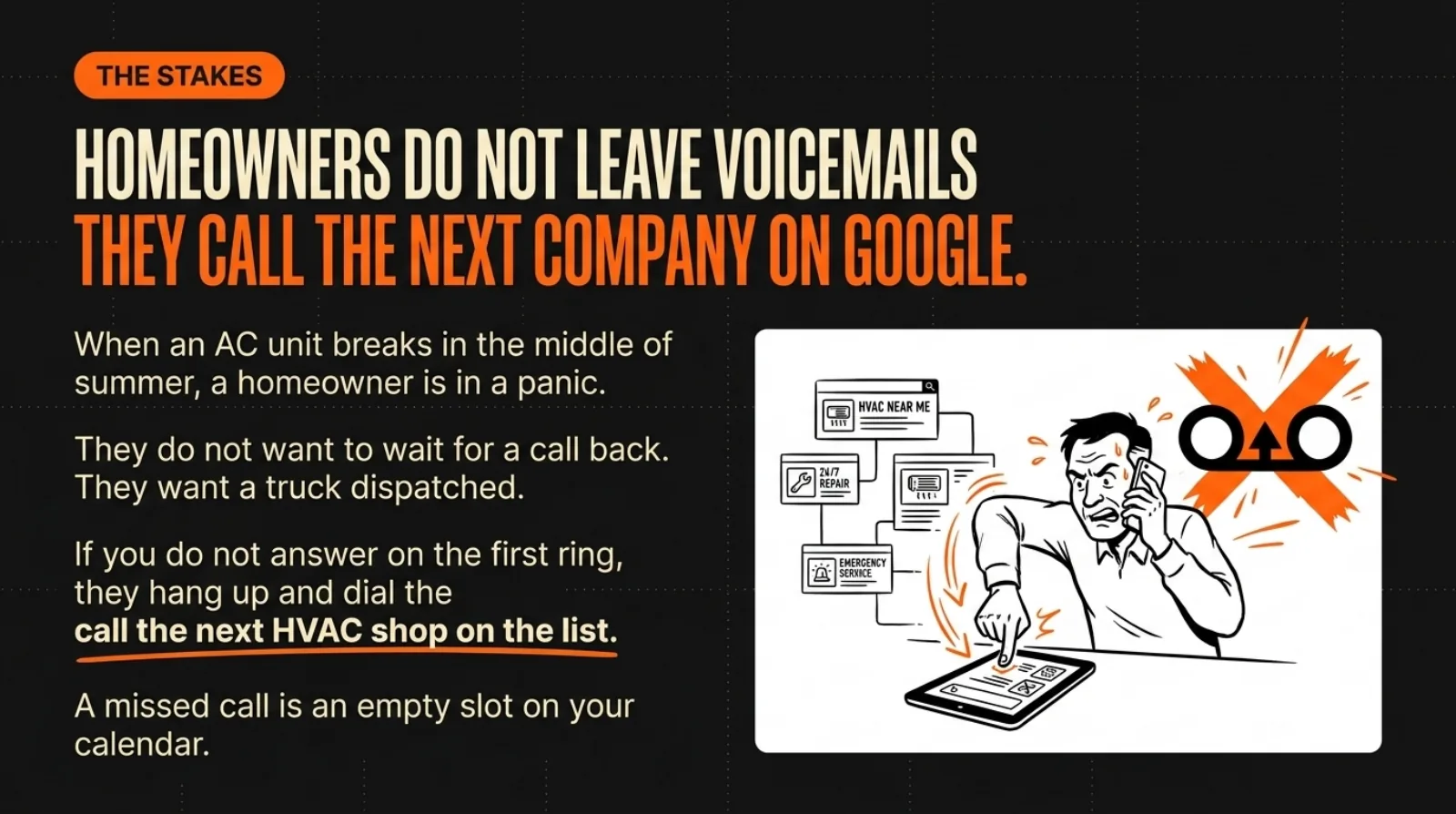
Here’s the uncomfortable truth about your real competition: it isn’t the biggest company in town. It’s the next listing on Google. When a customer with a burst pipe, a dead AC, or a Saturday appointment to book calls you and gets voicemail, they don’t leave a message — they call the next business on the list until someone answers. Your website and your phone are one system, whether you treat them that way or not.
The five parts of a website that books jobs
A site that generates leads for a service business isn’t one thing — it’s five parts working together. Miss any one and the others leak:
- Service-area pages that rank. Not one homepage — a page for each service and each city you cover. That’s what shows up when someone searches “[your trade] near me” at 9pm. It’s the difference between a 3-page brochure and a 25-page site that gets found.
- A Google Business Profile wired to the site. Most local searches start and end on the map. A verified, filled-out profile linked to real pages — with the same name, address, and phone everywhere — is half the battle for local rankings.
- Missed-call text-back. You cannot answer the phone on a ladder, under a sink, or mid-cut. A 60-second automatic text — “Sorry we missed you, what do you need?” — keeps the customer from dialing the next company. This one part pays for the whole system.
- A review engine. Buyers read reviews before they call anyone. A steady, asked-for stream of them — requested automatically after every job — builds the proof that makes your listing the safe choice.
- One lead inbox. Calls, texts, and form fills in one app on your phone. Leads die in scattered inboxes; they close when you see and answer them in minutes.
What missed calls cost, trade by trade
The stakes are different depending on what you do — but they’re real in every trade:
| Trade | The leak |
|---|---|
| Roofing | One caught call can be an $8,000–$20,000 job — one save pays for years of the system |
| Plumbing · HVAC · handyman | Emergency calls go to whoever answers first; $175–$900 walks per miss |
| Barbershops · groomers · detailers · phone repair | 10–30 calls a day — every missed booking is a competitor’s new regular |
| Landscaping | One missed call can be a recurring contract — thousands per year, gone quietly |
At a conservative $75 ticket, 10 missed calls a week leaks about $14,400 a year. Put your own numbers in the Missed Call Revenue Calculator and see your leak — most owners are off by 3x when they guess.
Your options: DIY, freelancer, agency, or done-for-you
Four ways to get there, and each charges you differently — in evenings, in invoices, or in retainers. DIY builders hand you homework. Freelancers ship a site and move on. Agencies build well but bill like it, on 6–12 week timelines. A done-for-you system is the middle path: built and managed for you, priced for an owner-operator, and paid to catch leads — not to ship a deliverable and disappear.
The full three-way comparison lives in Agency vs DIY vs Done-for-You, and the price breakdown with real 2026 numbers is here: How much does a website cost for a local service business?
How J1 Systems does it
J1 Systems installs all five parts as one system for a flat $297/month — site, Google profile, missed-call text-back, review engine, and lead app — live in days, not agency months. And it’s built in the open: Jacob Chappell builds these systems for real businesses live on camera every day, so you can watch exactly how the work gets done before you ever book a call.
The guarantee puts the risk on us: live in 14 days or your month is free · 30 days unconditional · after that, we keep working free until it performs.
Book a call — bring your trade and your city; we’ll map the system for your business on the call.
Frequently asked questions
How do I get more calls from my website?
Three moves cover most of it: service-area pages for every city you work (so you show up in more searches), a verified Google Business Profile linked to the site (so the map sends you calls), and missed-call text-back (so the calls you can’t answer don’t bounce to a competitor). Traffic without capture is where most sites fail.
I get all my work from referrals — do I still need a website?
Referrals check you out before they call — roughly 8 in 10 look you up first. A referral who finds nothing, or a dead Facebook page, cools off. The website’s job isn’t replacing referrals; it’s making sure the ones you’ve already earned actually convert.
Is a Facebook page enough for a local business?
No. Facebook pages don’t rank for local service searches, don’t show your service area, bury your reviews, and log customers out at the door. A real site plus a Google Business Profile is what shows up when buyers search — Facebook is a fine extra, not a foundation.
My website gets visitors but no leads — why?
That’s a capture problem, not a traffic problem. The usual culprits: no clear phone number and booking button at the top, no text-back when calls miss, slow follow-up on form fills, and thin reviews that send buyers elsewhere for the final check. Fix capture before spending anything on more traffic.
How fast can a website go live?
Days. Agencies quote 6–12 weeks because of their process, not the work. J1 Systems guarantees live in 14 days or your month is free — most builds land well inside that.
The short version, on camera
Everything a homeowner decides about your company happens in the part of the page that loads before they scroll. Three takes on what belongs up there.
Your website has 5 seconds to answer these 3 questions
What you do, where you work, and how fast you can get there. Miss one of the three and the visitor is already reading a competitor.
Your website is losing jobs without these 5 trust signals
Five things that sit above the fold on the sites that book work, and are missing from the ones that only look finished.
Most Service Business Websites Fail This Simple Test
Everything a homeowner decides about you happens above the fold, before a single scroll. This is what has to be up there.