The five leaks, at a glance
When an AC dies in July, a pipe bursts, or a roof starts dripping into the hallway, the homeowner follows a simple path: search, size you up, reach out, wait for an answer. A leak is any point on that path where they quietly give up and call the next shop. Traffic with no calls means the leaks are winning. Here are the five that show up in almost every home service business, whether you run an HVAC crew, a roofing company, a plumbing outfit, or a one-truck handyman shop:
| The leak | What it looks like | The plug |
|---|---|---|
| The search leak | A Google profile full of stock photos and vague services | Real photos, outcome-first descriptions |
| The trust leak | No license or insurance proof anywhere | License number front and center |
| The engagement leak | “Call us” is the only way in | Quote form and web chat for the quiet traffic |
| The phone leak | Missed calls going to voicemail | An instant text back on every missed call |
| The friction leak | Leads scattered across ten logins, no follow-up | One inbox, every lead nurtured |
You do not need more traffic. You need the traffic you already paid for to stop leaking. Here is each leak and how to plug it.
Your Google profile is where the leak starts
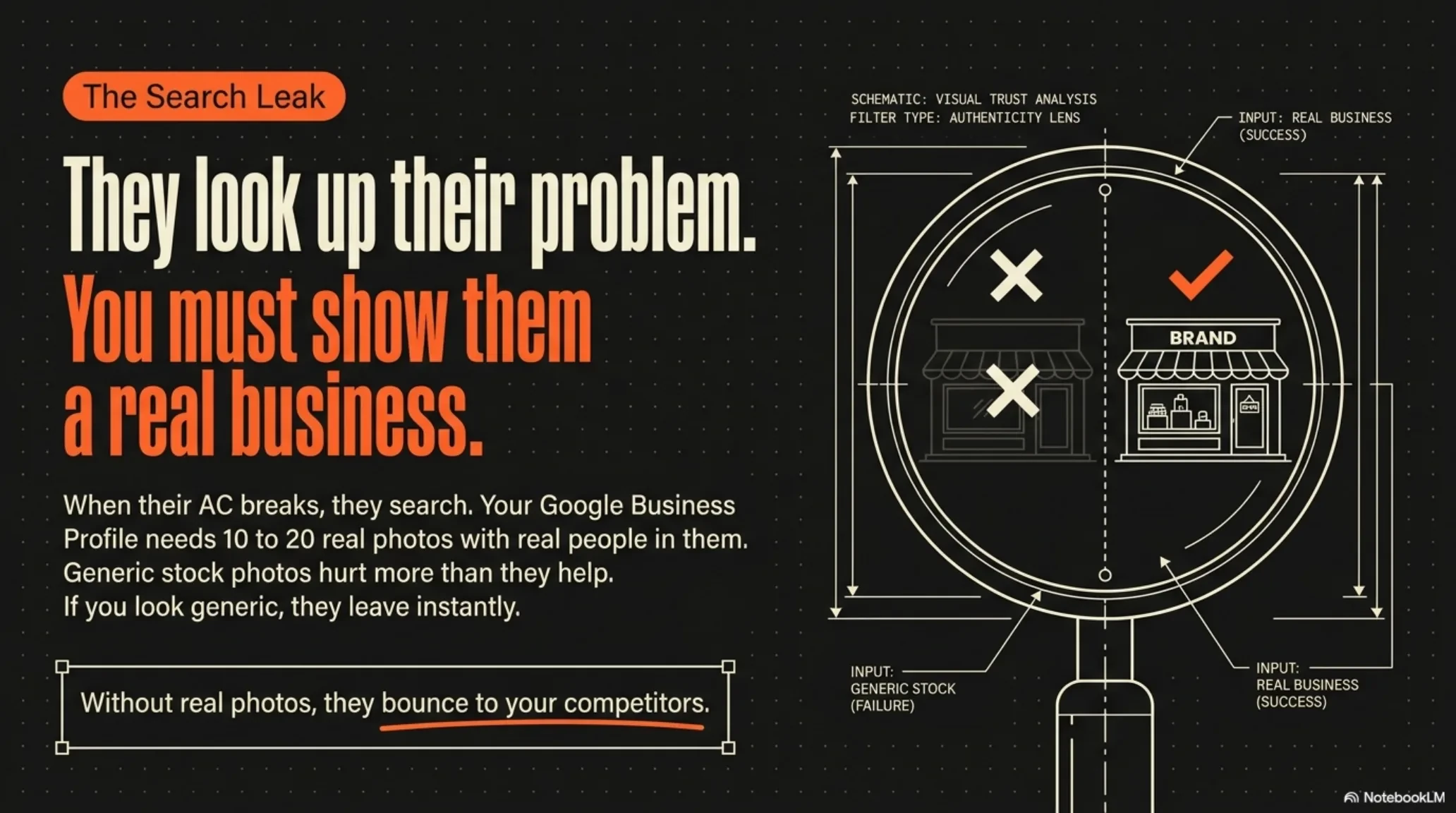
Your Google Business Profile is usually the first thing a customer sees. It is the digital version of your truck pulling into their driveway. If it looks like a generic template, you lost the job before your phone ever had a chance to ring. And the fastest way to look generic is stock photos. Customers can spot a manufactured photo of a smiling model in a hardhat from a mile away.
They want to see the actual people who will be walking into their living room or climbing onto their roof. Aim for at least 10 real photos, and 20 is the sweet spot. The crew, the trucks, the work in progress. Real beats polished every time.
Then fix the words. Stop listing what you do and start listing what the customer gets. Nobody cares about the specs of a compressor or the brand of sealant on the truck. They care about how fast their problem goes away. Put fix-time expectations right in your description: 24 hours, 48 hours, 72 hours, whatever you can actually stand behind. That one change makes you the obvious pick over the competitor whose profile just says “HVAC Repair” or “Landscaping Services.” If you are wondering how the profile and the website split the work, that is its own question, and the answer is you need both working together.
Show your license number and win the trust battle
There is a real problem in home services right now: fake lead sites. They look legitimate, but they are shells that harvest the customer’s information and sell it to whoever is paying for leads that week. The homeowner thinks they found a vetted local company and ends up with a stranger who may not even be licensed.
Homeowners are catching on, and they are skeptical, especially on big-ticket work like a roof replacement or a full system install. That skepticism is your opening. Put your license number and proof of insurance clearly on your website and your Google profile. In Arizona, your ROC number is a massive trust signal, and every state has its equivalent. When a customer compares two companies and only one shows its license, that one wins the trust battle every time. It is one of the cheapest fixes on this list, and it is exactly the kind of detail a website built to book jobs puts front and center.
Not everyone wants to call you
Most home service websites give the customer exactly one way in: call the office. Calls are great, but a phone call is a commitment. A big slice of your traffic is sitting in an office, or on the couch at 9pm, and does not want a live conversation yet. If calling is the only option, that slice hits the back button and keeps scrolling.
Give the quiet traffic a path:
- A quote form, so they can drop their name and number on their own terms and get the process started.
- A web chat, so they can ask a quick question and get instant feedback without picking up the phone.
- The phone number, still right there for the ones who are ready to talk now.
Multiple ways in means fewer people bouncing back to Google to find someone easier to reach. The customers who engage on their own terms today become the booked jobs of tomorrow.
The missed call leak is the expensive one
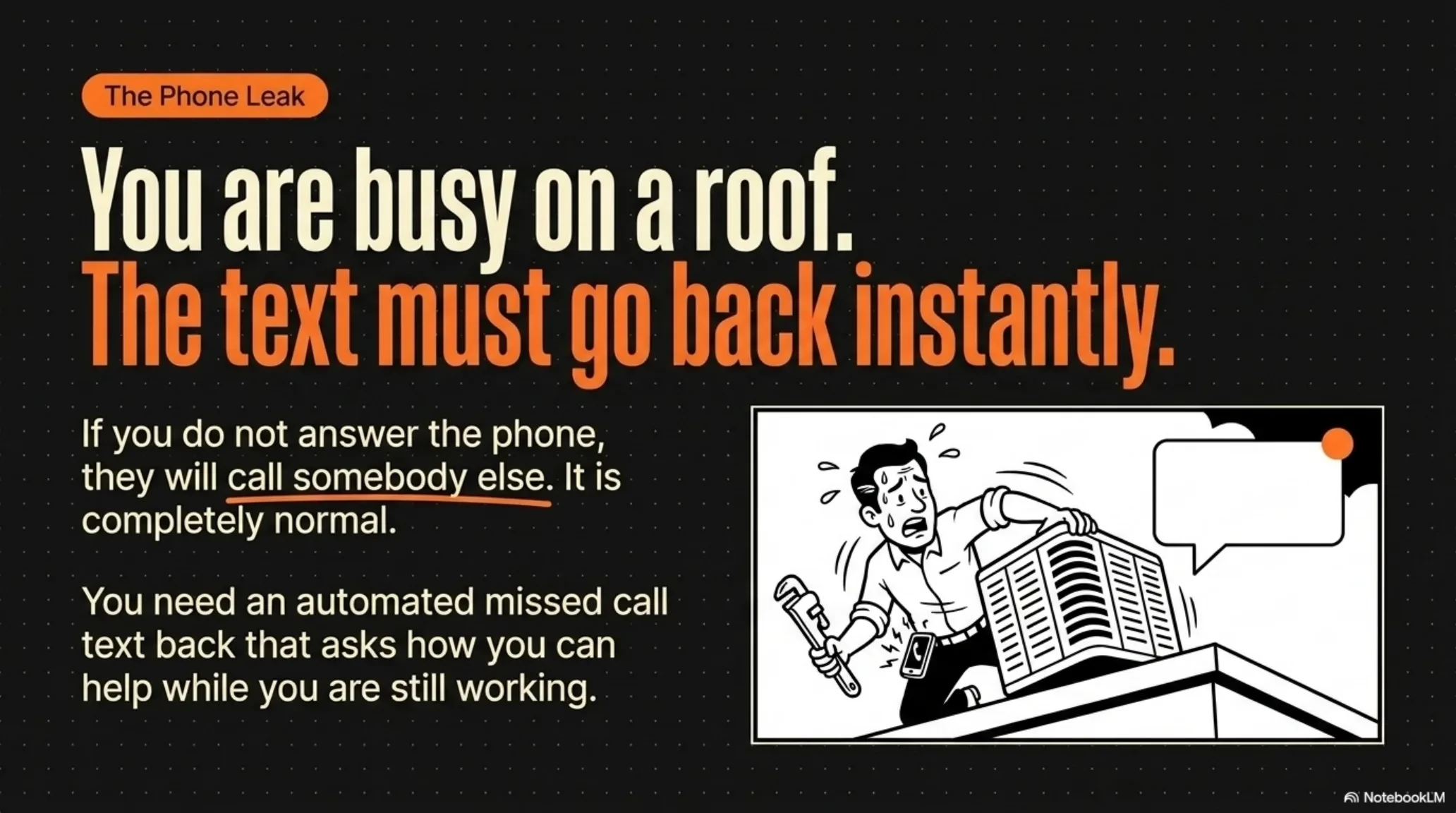
The fastest way to burn money in this business: pay for marketing, get the phone to ring, and let it go to voicemail. In home services, the first shop to respond usually gets the job. When you are on a roof, under a sink, or halfway through a job and a call slips by, that homeowner is not waiting for you to check voicemail. They are already dialing the next name on the list.
The plug is an automated text that goes back the second a call is missed. Something as simple as “Sorry, I am with a customer right now. How can I help?” is often enough to stop them from calling the competitor. It starts a conversation and buys you the time to finish the job in front of you. That is the whole idea behind missed-call text-back: the customer feels heard in under a minute, even when you cannot pick up. If you want to know what this leak alone is costing you, run your numbers through the Missed Call Revenue Calculator.
Ten logins is how warm leads get ghosted
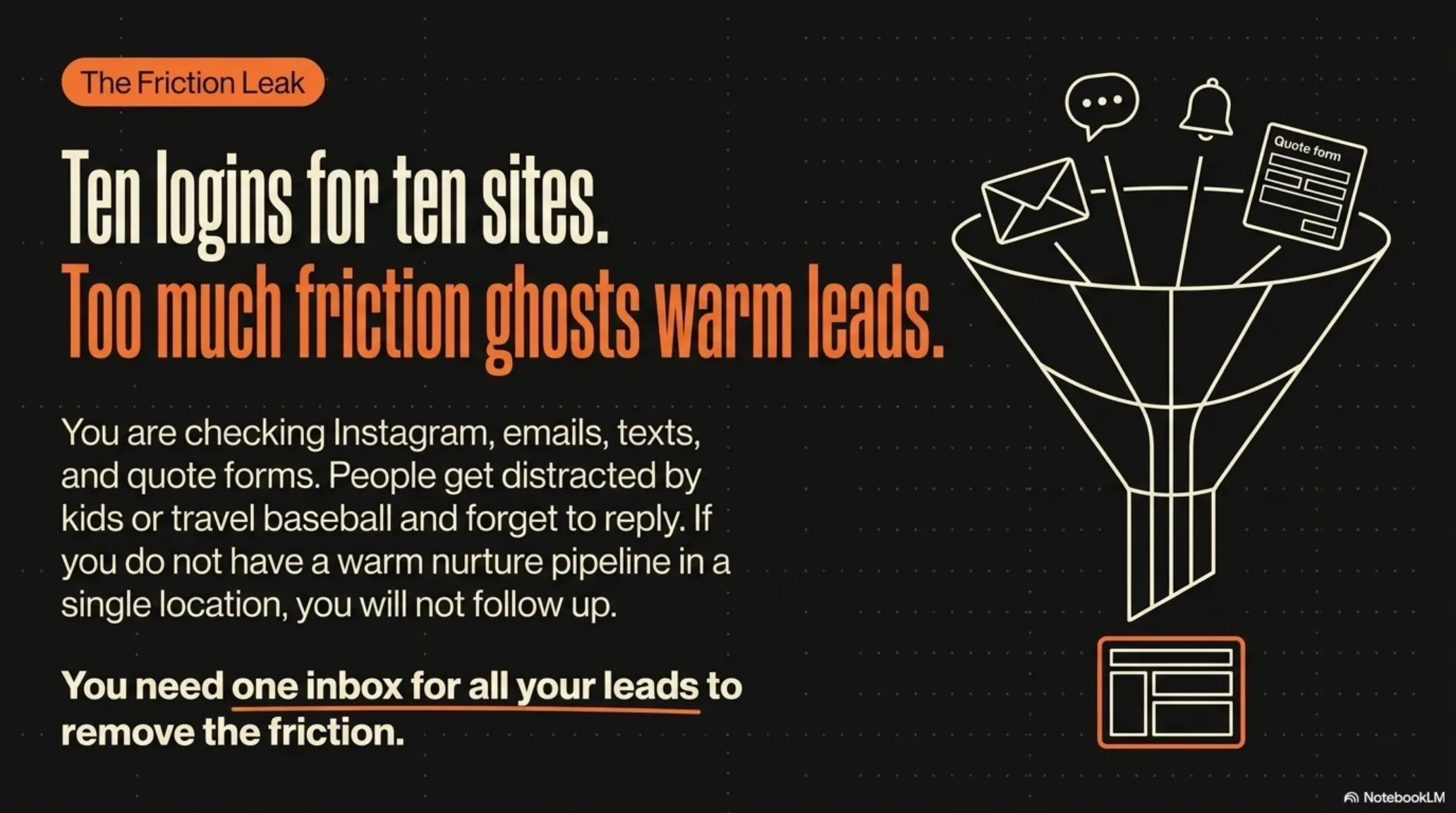
Friction is the quiet killer. Messages come in from Facebook, Instagram, the website form, email, and texts, and checking ten different logins just to see who is trying to give you money is a full-time job nobody is doing. Things get missed. Not because you do not care, but because the leads are scattered.
The fix is one inbox. Every lead from every platform lands in a single place, so you see your whole pipeline without app-hopping. When the friction disappears, the follow-up actually happens.
And follow-up is the second half of this leak. Too many shops send a quote and then wait. No reply must mean no interest, right? Wrong. Customers are busy people with jobs, kids, and travel baseball eating their weekends. They wanted the work done and simply forgot to hit send. A simple check-in text is not annoying, it is a service. The fortune in this business is in the follow-up, not the first contact. This is the part most owners end up handing to a done-for-you system because it is relentless in a way a busy human cannot be.
Close the reputation loop
A job is not finished when the truck pulls away. It is finished when the work turns into a review and the review turns into the next job. Good reviews are the engine of organic growth in a local market, and they do not show up on their own.
Ask while you are still in the driveway. If the customer is smiling, that is the moment. Most people are glad to help a local business when you make it easy. Then reply to every review you get, because you are not writing to that customer, you are writing to every future customer who reads your profile. When they see a real human responding, that is trust no ad budget can buy. If a bad one lands, there is a right way to answer it that wins you jobs anyway.
Frequently asked questions
What if I am just starting out and have no reviews yet?
Be aggressive about the first five to ten. Every time you finish a job and the customer is happy, ask right then, on the spot. Tell them you are a local shop trying to grow and a review helps more than anything else. Most people say yes when the work was good.
Why is a web chat better than just having my phone number on the site?
It meets the customer where they are. Some people are at work or somewhere they cannot make a call. Others do not want to talk to anyone until they have basic information. A chat is a lower-friction way in, so you capture the lead instead of losing it to the back button.
How many photos does my Google profile actually need?
Ten is the minimum to not look like a ghost town, and twenty is the sweet spot. They must be real: your trucks, your team in uniform, your actual work. One genuine job-site photo is worth a thousand stock images.
Why do license numbers suddenly matter so much?
Because fake lead sites burned a lot of homeowners. People got passed to unlicensed strangers by pages that looked legitimate, so now they check. Showing your license and insurance clearly proves you are the real thing, and it wins the comparison against any competitor who stays vague.