The call you cannot answer is the one that pays the most
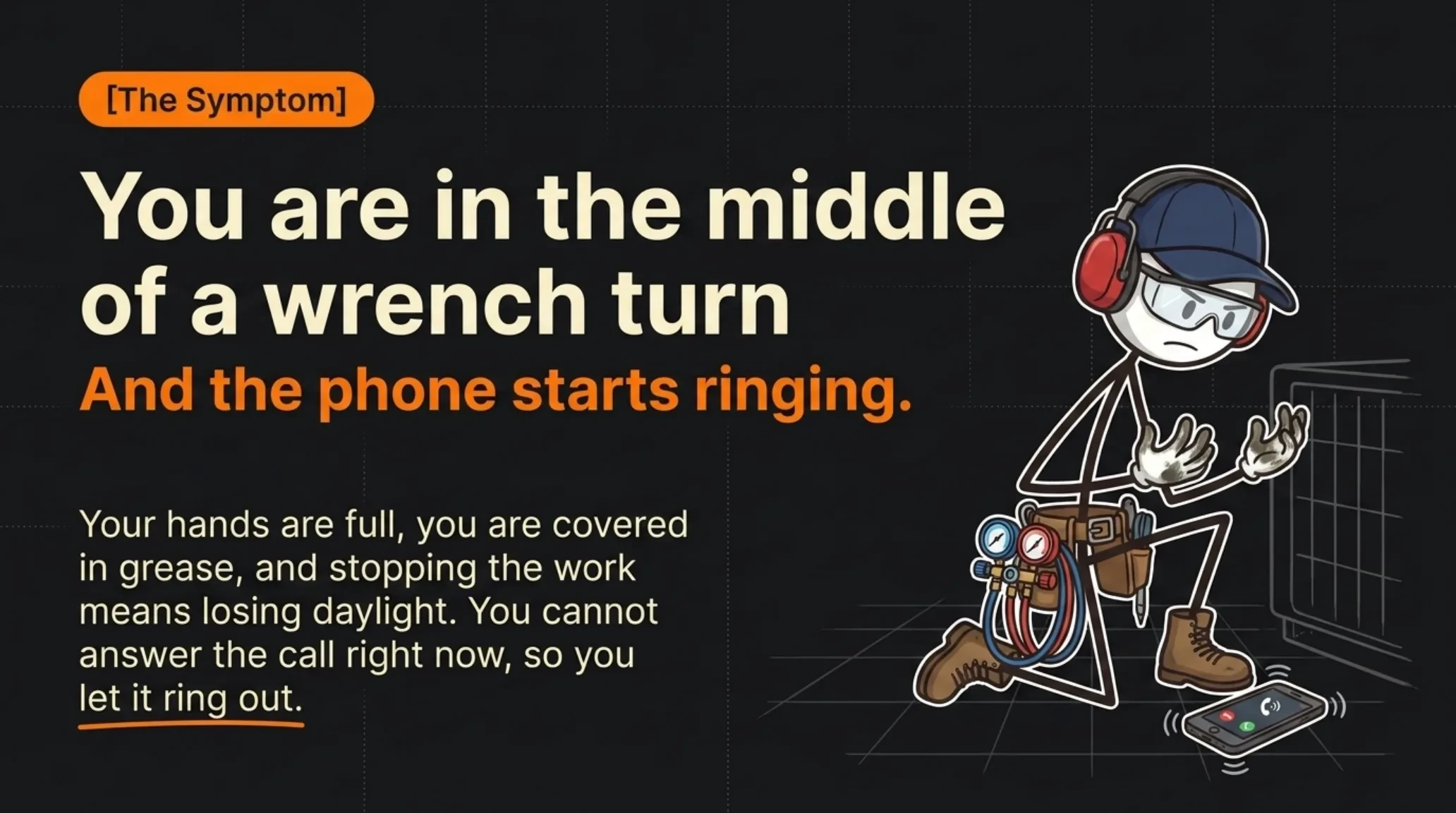
You are under a house with your hands in a unit and your phone is buzzing on the dirt floor next to you. Local number, not one you recognize. You cannot stop what you are doing, so you let it ring out. By the time you crawl out, wipe your hands, and play the voicemail, that homeowner has already worked down the search results and found somebody who picked up.
That is the expensive part of running a shop, and it does not feel expensive while it is happening. It feels like a normal Tuesday. The service call you are on quietly costs you the install you were hoping to sell, and nothing in your day ever tells you it happened.
What ten missed calls a week costs an HVAC shop
The numbers behind this are not dramatic, which is exactly why owners ignore them. Around 62 percent of calls to contractors go unanswered. Ten of those a week is a slow week for most shops.
| What happens | The number |
|---|---|
| Missed calls per week | 10 |
| Close rate on the ones you actually talk to | 40% |
| Lost jobs per week | 4 |
| Lost jobs per year | about 200 |
I am deliberately not putting a dollar figure at the bottom of that table. Two hundred jobs means something completely different to a shop living on diagnostics and capacitor swaps than it does to one selling changeouts, and any number I picked would be wrong for half the people reading this. What does not change across either shop is the count. Two hundred conversations a year that you never had.
The mix is the part that stings. Some of those calls were a capacitor. Some of them were a twenty year old system that finally quit in August, and that homeowner bought from whoever picked up the phone. You do not get to know which ones you lost, because a call that never connects leaves no evidence behind. If you want the dollar figure for your shop rather than an average one, put your real call volume and your real ticket into the calculator.
The immediate save: a text goes back in under a minute
When a call comes in and nobody picks up, a text goes back to that caller in under a minute. It says you are on a job and asks what they need. That is the whole move, and it is the one that does the most work.
The homeowner stops searching. They are now in a two way text conversation with your shop while the problem is still fresh, which means they are off the market before your competitor’s phone ever rings. You did not touch your phone. You finished the repair and answered the text on the way to the truck. If you want the mechanics of it, here is what missed call text-back actually is.
Web leads that text your phone instead of dying in your inbox
Most contractor websites are lead graveyards. Somebody fills out a quote form at 4pm, it fires an email, and the email sits there until you open your laptop at nine o’clock at night. By then the job belongs to whoever answered first.
Chats and quote forms should text your phone the moment somebody hits send, not queue up an email you will read after dinner. You reply with a thumb tap in the driveway and the lead never goes cold. That is the difference between a brochure and a website built to book jobs.
Four apps, four half-finished conversations
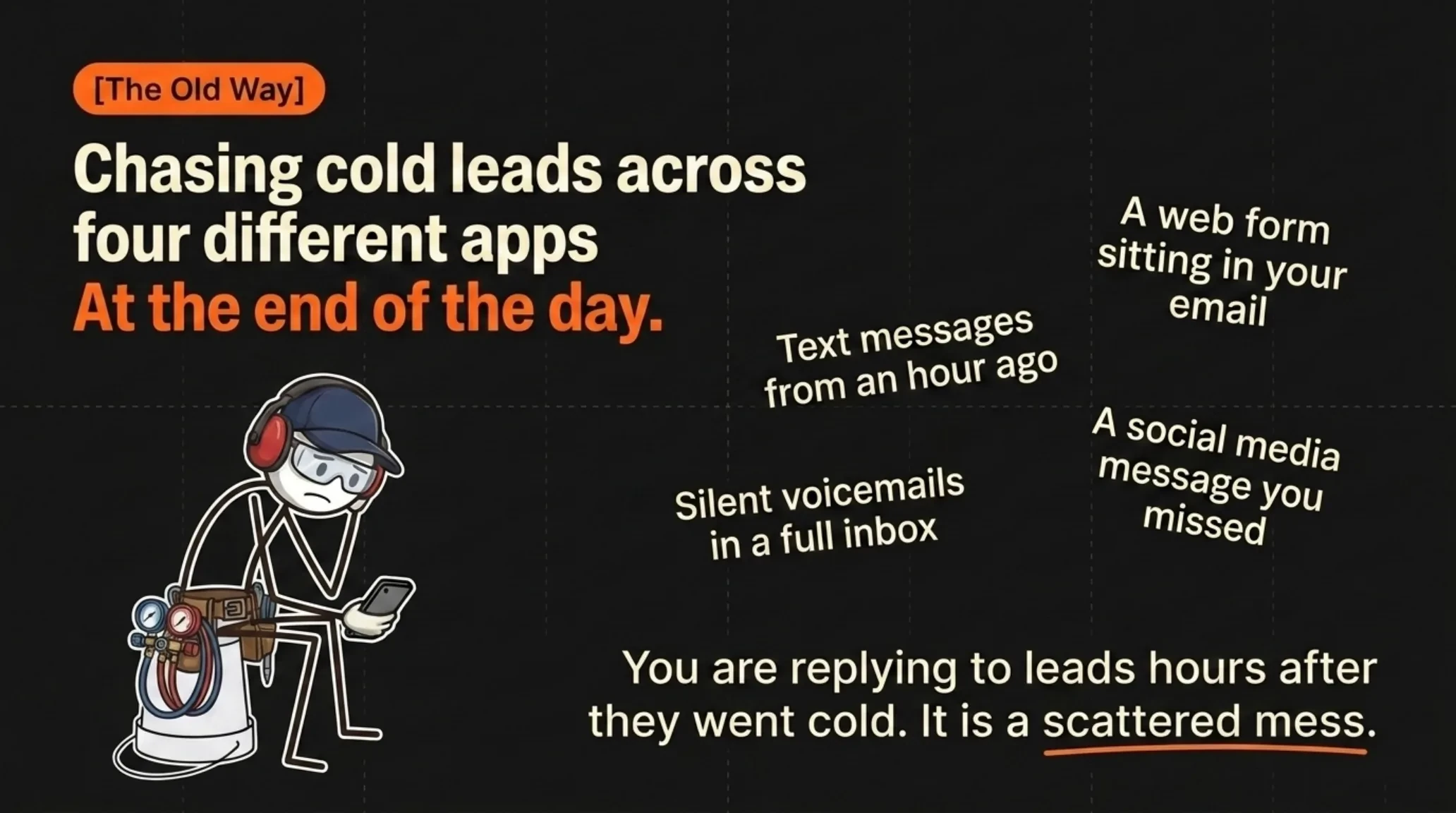
Count what you are actually checking right now. Voicemail. Text messages. The email your web form dumps into. Your Google profile. A Facebook page somebody messaged three days ago. Five places, and no single one of them tells you who is still waiting on an answer.
Nothing gets lost dramatically. It gets lost quietly, because you answered four of the five and never noticed the fifth. The leak is not laziness, it is the number of places a lead can hide.
One app, every conversation
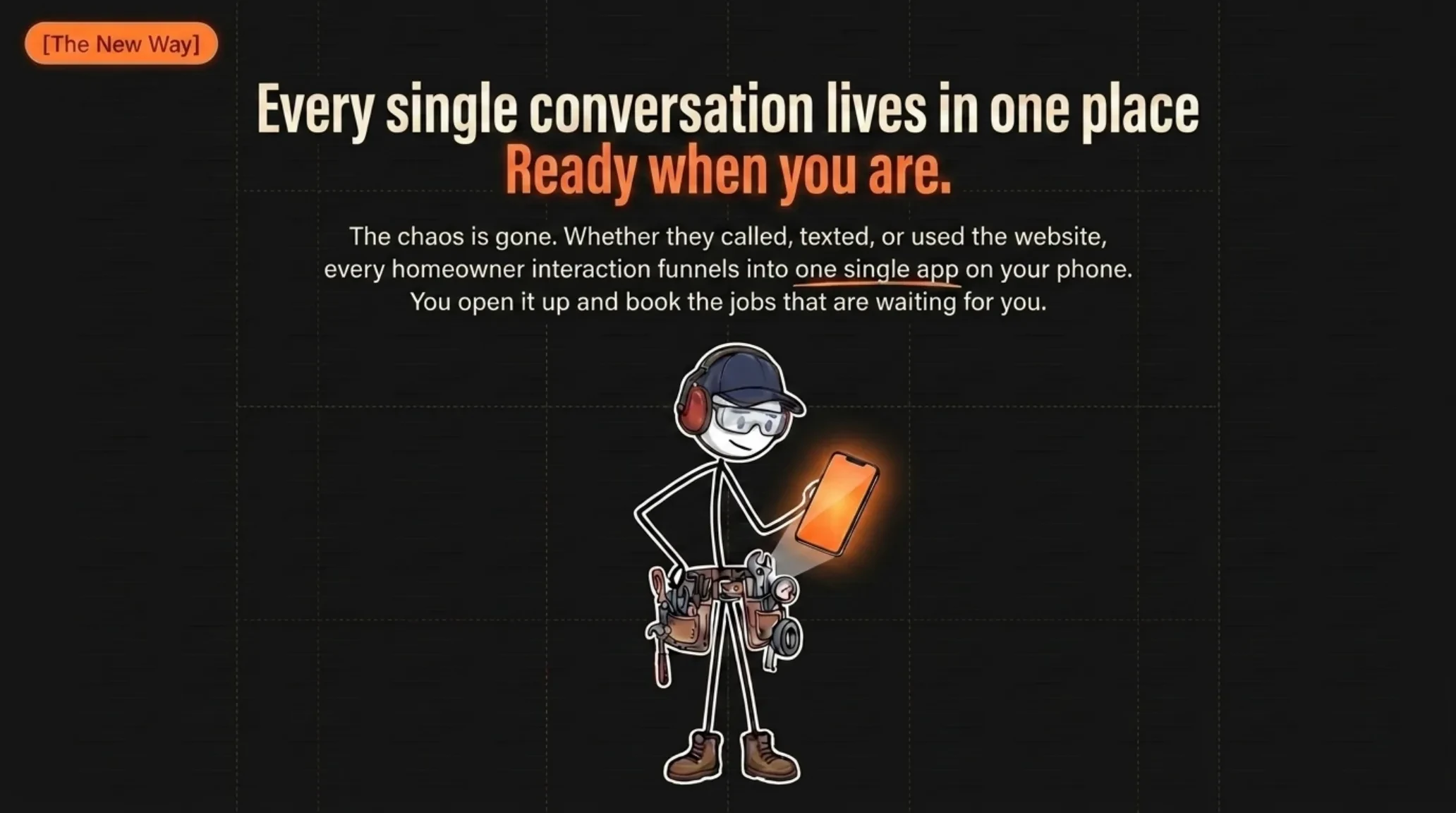
Calls, texts, web forms, social messages, and Google messages land in one inbox on your phone, in one timeline per customer. You open it in the truck and work the list top to bottom.
You stop asking yourself where that guy messaged you from. If somebody is waiting on you, they are on the screen, and when the screen is clear you are actually caught up, for the first time in a long time.
Follow-up and review requests that happen without you
Most jobs are not lost at the quote. They are lost two weeks later, when you gave a homeowner a price for a new system and then got buried in three emergency repairs and forgot to circle back. Follow-up messages go out on their own schedule, not on the nights you remember.
Same story with reviews. A review request goes out by text as soon as the job is marked complete, while the house is finally cool and the customer likes you. Every customer gets asked, not just the ones you happen to think of, which is the entire trick behind shops with hundreds of reviews. More on that in how to get more Google reviews without begging.
The old way against the new way
| The old way | With a lead system |
|---|---|
| Missed calls go to voicemail and die | A text goes back in under a minute and starts a conversation |
| Web leads sit in email until 9pm | Web leads text your phone the second they hit send |
| Five apps, no single list of who is waiting | Every lead source in one inbox on your phone |
| Follow-up happens when you remember | Follow-up runs on its own while you are on the tools |
| Reviews asked for by hand, when you think of it | Every completed job gets a review request by text |
You are not the one building it
Most owners have a folder of software they paid for and never set up, because the setup was the real cost and nobody told them that up front. This is installed and managed for you, not handed to you as a login. You do not watch tutorials and you do not troubleshoot notifications.
Kickoff happens within 24 hours of signing. The site gets designed, the lead system gets wired, every automation gets tested, and the whole thing is live on your domain in 14 days. The texting line goes live on carrier approval, which runs on the carriers’ clock and not mine. It is month to month with no long term contract, and if you want to see the numbers before you talk to anybody, here is what this actually costs.
I build these live every day
This is not a theory I read about. I build these systems for home service businesses live on camera every day, and the same thing happens every time: the shop that answers first gets the job, and the shop with better equipment and a better crew loses it because the phone rang at the wrong moment. Speed is the only part of this the customer can see.
Frequently asked questions
I am too busy to learn new software. Do I have to manage this?▾
No, because you do not run it. It gets installed, configured, and maintained for you. Your only job is answering the leads that show up in the app, the same way you answer a customer text today.
I do not want a robot talking to my customers. Is this personal?▾
The text-back starts a human conversation, it does not replace one. The first message tells the caller you are on a job and asks what they need. You take it from there in your own words. It buys you the ten minutes you need to get out from under the house.
Is there a long term contract?▾
No. It is month to month and you can cancel. The system has to earn its keep every month by catching jobs that used to disappear into voicemail, which is a fair way to be judged.
How fast can we start?▾
Kickoff is within 24 hours of signing, and the site and lead system are built, tested, and live on your domain in 14 days. The texting line switches on when the carriers approve the registration, which is their timeline and runs about 10 to 15 business days.